Scenario analysis shows whether sustainability investments can still pay off when prices, adoption, costs or timing miss expectations.

For sustainability teams competing for limited capital, a strong expected return may not be enough. Finance leaders also want to know what happens when the forecast misses. A business case that answers that question can make uncertainty visible, expose fragile assumptions early and give executives a clearer basis for deciding.
The pressure is acute heading into the 2027 budget season. In a fourth-quarter 2026 survey of 131 CEOs by the Conference Board, 41 percent expected economic conditions to worsen, compared with 19 percent the previous quarter. CEO confidence had turned negative, and most respondents said they had no plans to increase capital spending.
Sustainability projects already face particular scrutiny. In a 2023 survey of 1,000 finance leaders, EY found that 37 percent planned to cut or pause ESG spending within a year, even as they described it as a long-term priority. A 2025 Kearney survey of 500 CFOs found that 61 percent assessed sustainable investments mainly through a cost lens. In that setting, a projected return needs to withstand more than a quick review of its headline number.
Uncertainty has a cost
Many sustainability projects depend on variables that can shift: commodity prices, customer demand, carbon rules, adoption rates and operating costs. When those inputs are uncertain, decision-makers may discount a forecast even if its expected return looks attractive. Behavioral economists call this ambiguity aversion: people tend to prefer risks with known odds to situations where the odds themselves are unclear.
Research on investment decisions offers a useful parallel. A study of investors and non-investors by Wharton risk management professor Olivia Mitchell and colleagues found that most participants were averse to ambiguity. Participants who perceived less ambiguity in an asset were more likely to invest in it.
A business case with assumptions that have never been tested presents the same challenge. A reviewer can’t tell whether the economics survive a fall in material prices, a slower rollout or higher labor costs. That uncertainty can make a project seem riskier than the forecast suggests. The practical response is to show how the return changes when the assumptions do.
Six parts of a decision-ready case
A useful business case connects a proposed action to a financial result and makes the alternatives clear. Drawing on the HBR Guide to Building Your Business Case and HM Treasury’s business case guidance, the author identifies six elements:
- A defined actor and goal. Name the company or business unit making the decision and the outcome it needs.
- A specific action. Describe a project that can be approved, funded and started.
- A net financial result. Put the expected benefits and costs in monetary terms.
- A clear connection between action and result. Explain how the project changes revenue, margins or costs.
- A comparison with alternatives. Include business as usual, since continuing current operations is also a choice and may carry costs.
- An account of what could go wrong. Show how the financial result changes if key assumptions fail.
The last element is often absent. Valutus, which analyzes the quality of sustainability business-case coverage, reviewed a random sample of 300 writeups from a pool of 1,587 publications issued in 2025 and 2026. The sample was split evenly across six categories: academic papers; consultancy articles; vendor and company cases; trade press pieces; business school cases; and NGO, government and industry writeups.
Only about 8 percent of the 300 publications examined what would happen if their assumptions proved wrong. That gap matters because reviewers need to judge not only the expected outcome, but also how much confidence to place in it. Stress testing makes that judgment possible.
Put the assumptions under pressure
Start by documenting the base case. List the inputs behind the forecast, including prices, volumes, adoption, costs and timing. Record the source for each figure so reviewers can see which inputs come from observed data and which rely on estimates.
Next, find the few assumptions that drive most of the result. Change them one at a time and watch how the projected return moves. In many cases, two or three variables account for far more of the outcome than the rest. This step helps focus attention on the uncertainties that could actually change the decision.
Then build a deliberately pessimistic scenario. Set the key drivers to values that would be uncomfortable but still plausible to defend. The aim isn’t to invent the most extreme imaginable outcome; it’s to test the project against a bad year. Show the expected and pessimistic results side by side, and state the assumptions behind both.
Where the team has the right tools, a Monte Carlo simulation can extend this analysis. The model runs thousands of scenarios, varying multiple inputs at once, and shows the range of possible outcomes. That range can communicate the project’s exposure more clearly than a single forecast, though the quality of the result still depends on the assumptions fed into the model.
A waste recovery project tested 2,000 ways
One consulting example illustrates what this can look like. The client, a U.S. company with revenue in the billions, generated a large waste stream across dozens of sites. Analysis found that material going to landfill included recoverable copper, aluminum and steel. Selling those metals could create revenue, while reducing the volume sent to landfill by half could also lower disposal costs. A cost center could become a source of income.
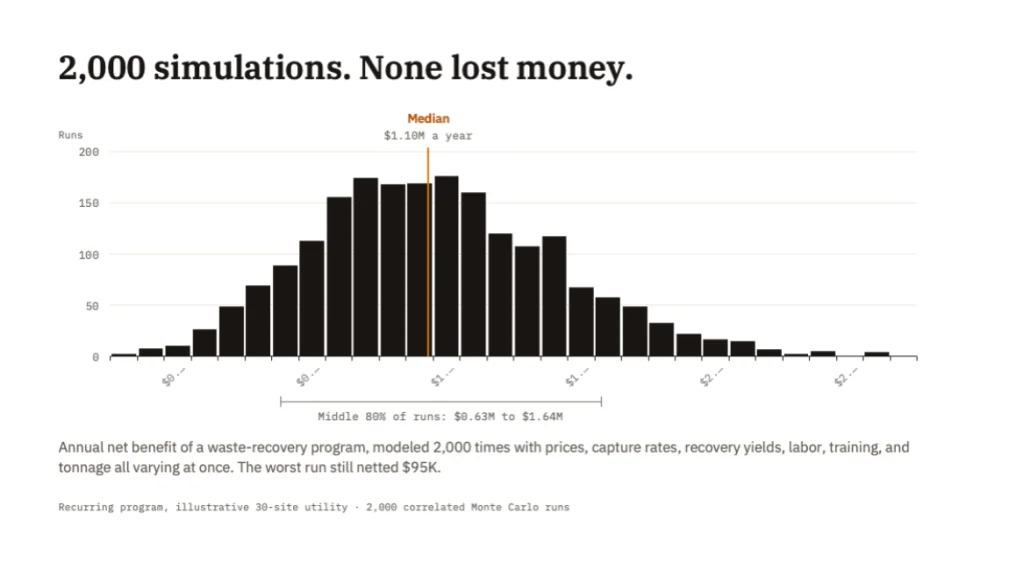
The initial financial case looked attractive, but the team tested how it would hold up under changing conditions. Valutus ran 2,000 scenarios, varying sale prices, capture rates, recovery yields, labor costs, training needs and other factors. The analysis included severe assumptions: one modeled copper-price decline was among only two drops of comparable size since 1967.
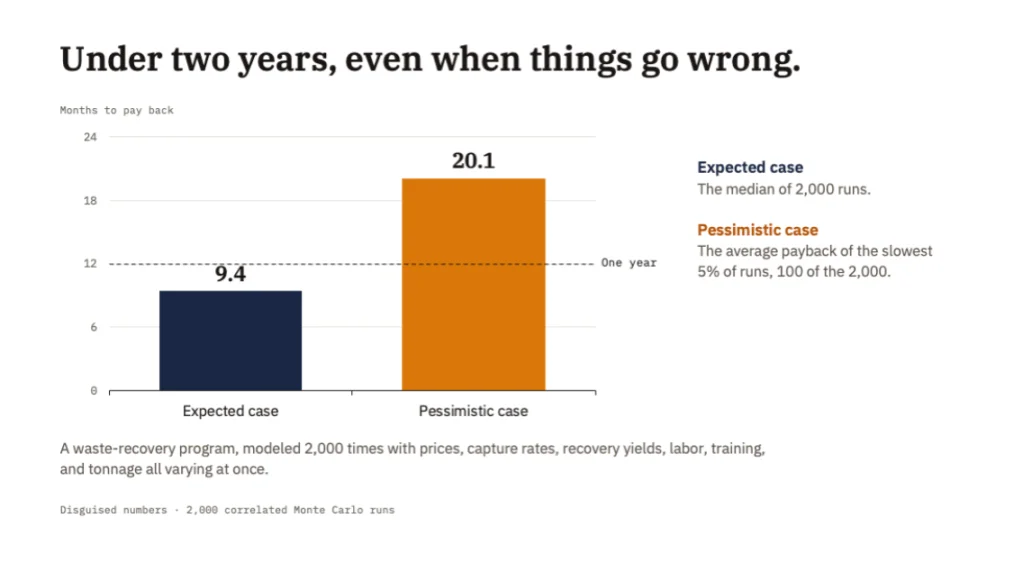
Across the simulations, the median annual benefit was $1.10 million, with a 9.4-month payback period. None of the 2,000 scenarios produced a loss. Even among the most pessimistic 5 percent, the average payback period was 20.1 months, or under two years.
That evidence changes how a payback claim sounds. “We expect payback in under a year” gives an executive one forecast. Pairing it with the results of 2,000 simulations also shows what happened when the inputs moved against the project: even the most pessimistic group of cases averaged a payback under two years.
Make the weak point visible
Stress testing helps a team identify its most vulnerable assumptions before a finance reviewer does. If the project still delivers a return in the pessimistic case, that resilience strengthens the case. If it doesn’t, the team has found a concrete issue to address, such as a cost that needs to fall, a rollout that needs to change or an assumption that needs better evidence.
It also signals that the sustainability team understands the conditions required for delivery. A case that names its risks and shows their financial effects gives reviewers more information than a forecast that presents only the expected outcome. The goal isn’t to make uncertainty disappear; it’s to show how much it matters to the decision.
As finance teams weigh requests in a constrained budget cycle, they’ll ask whether a project’s numbers survive when reality diverges from the plan. Sustainability leaders who answer that question with tested scenarios can make their proposals easier to assess—and can see sooner where a promising project needs a stronger design.
The opinions expressed by Trellis expert contributors are their own, not those of Trellis.
The post How, and why, to stress test your business case appeared first on Trellis.



Discussion
Sign in to join the discussion.