Clarity AI’s new assessment scores company climate progress across emissions, investment, technology and governance, with ratings tied to supporting evidence.
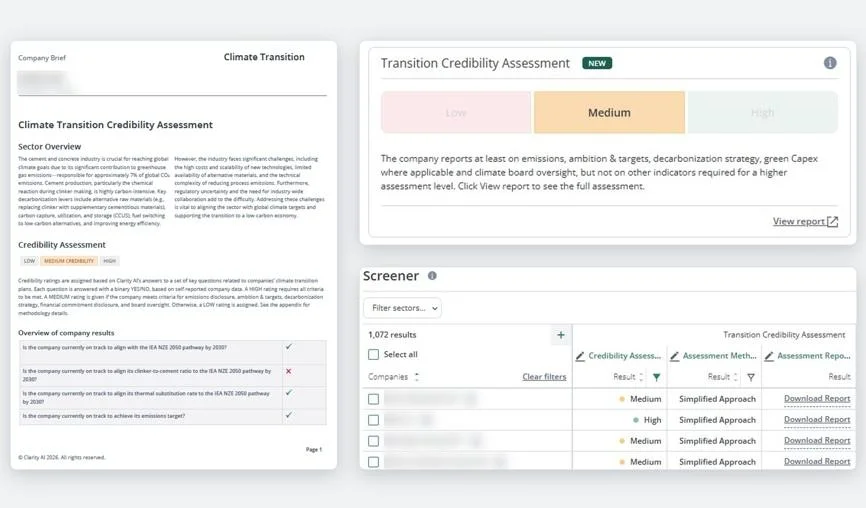
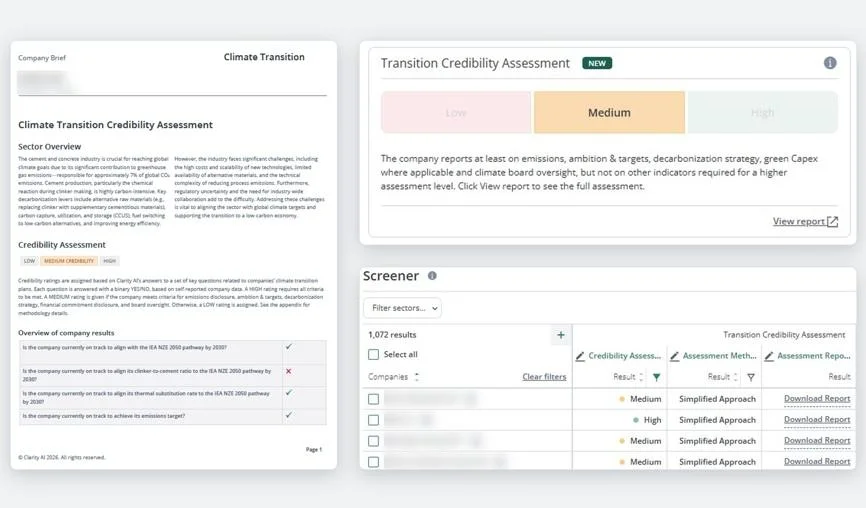
Clarity AI’s Transition Credibility Assessment is designed to help investors judge whether companies are acting on their climate commitments. Its premise is that the quality of a company’s reporting and the progress it’s making in the real world are related, but they aren’t the same thing. A company may describe its plans clearly without showing that its operations or spending are changing. Conversely, uneven disclosure can make progress harder to assess, even where some action is underway.
That distinction matters because climate targets are statements about intended outcomes, while a transition depends on decisions made over time. Investors assessing a company’s direction need to examine evidence of those decisions, not just the language used to describe them. The assessment’s approach separates these questions, giving users a way to consider both what a company reports and what its reported activity suggests about delivery.
Evidence across the transition
The assessment examines emissions performance, low-carbon technology deployment, disclosure, targets, decarbonization strategy, green capital expenditure and governance. Taken together, these categories cover several different parts of a company’s transition: its stated destination, the plans it presents, the money it allocates and the changes visible in its business. No single category can answer every question. A target may signal ambition, for example, but investors also need to understand whether the company has a strategy and is making investments consistent with it.
Each rating links back to its supporting evidence, giving investors a view into how the assessment was reached. That traceability is useful because a score on its own can conceal the reasoning behind it. When the underlying evidence is visible, a reader can ask whether the assessment rests on reported figures, disclosed plans or other documented activity, and can judge how well the evidence supports the rating. It also gives investors a clearer starting point for comparing a company’s claims with the information used to evaluate them.
Still, evidence doesn’t automatically settle the question of credibility. Reporting can be detailed yet leave important uncertainties about delivery, while performance measures can be difficult to interpret without sector context. A framework that lays out its evidence helps make those judgments more inspectable; it can’t remove the judgment involved. That’s a meaningful distinction for users who need to understand not only the result, but also what the result does and doesn’t establish.
Clarity AI applies detailed criteria to high-impact sectors and a sub-industry-calibrated approach to other companies. The distinction recognizes that the signals of transition aren’t identical across the economy. Emissions, technology choices and investment needs vary by industry, so a common set of questions may need sector-specific interpretation to produce useful comparisons. Calibration can make an assessment more relevant to the activity being measured, though investors still need to read the evidence in light of each company’s circumstances.
Its methodology draws on sector-specific net zero pathways and established frameworks, including the Transition Plan Taskforce Disclosure Recommendations and the Climate Action 100+ Net Zero Company Benchmark. Those references provide a basis for assessing plans and disclosures against recognized expectations. They also help situate the assessment within work that already focuses on climate transition planning. Using established frameworks doesn’t, by itself, prove that a company will meet its commitments; it gives the assessment a structure for examining what companies say and do.
Targets and the delivery gap
Corporate climate targets have become widespread, while evidence of delivery remains uneven. That gap is sharpening investor focus on implementation. “There is no shortage of climate targets. What investors need to understand is whether companies are taking the steps needed to meet them,” said Alice Borgonovo, Clarity AI’s Senior Product Manager responsible for Climate Solutions.
The point is straightforward, but its practical consequences are easy to overlook. A target can be precise and still leave unanswered questions about how a company expects to reach it. Investors may want to know whether the strategy is reflected in emissions performance, investment choices, technology deployment and governance. These indicators aren’t interchangeable, and a positive signal in one area doesn’t necessarily resolve concerns in another. The assessment’s value will depend in part on whether it helps users see those differences rather than flattening them into a single impression.
Borgonovo said a credible transition plan should be visible in emissions, investment and deployed technologies. The assessment aims to show where that evidence comes from, sector by sector—a practical way to distinguish stated ambition from measurable progress. That focus puts implementation at the center of the analysis: what companies are doing, what they’re funding and whether observable changes align with their stated direction.
What investors can take from the assessment
This is more significant than it looks: separating reporting quality from real-world progress pushes readers to treat disclosure as evidence to examine, rather than as proof of delivery. Clear reporting can make a company easier to assess, but it isn’t the same as a credible transition. Equally, an assessment should make clear when conclusions are limited by the evidence available. If you’re working in this space, that separation can help sharpen questions for company analysis and make comparisons more specific.
And this is the part most people overlook: a rating is only as useful as the evidence and criteria behind it. Linking ratings to support gives investors a way to inspect the route from information to judgment, but they’ll still need to decide how much weight each indicator deserves. Sector calibration may help make that judgment more grounded. It won’t make every company directly comparable, or remove the need to consider how a particular business operates.
Here’s the thing: climate transition assessments are tools for organizing evidence, not guarantees about what a company will achieve. Their usefulness depends on whether the information is current, relevant and detailed enough to support the conclusions being drawn. The assessment described by Clarity AI is aimed at making those inputs more visible and at distinguishing plans from signs of execution. For investors, that’s a practical lens on an important question. The hard work is still in the evidence.



Discussion
Sign in to join the discussion.