The dashboard helps property investors, asset managers and lenders screen climate exposure, estimate retrofit costs and assess building value.
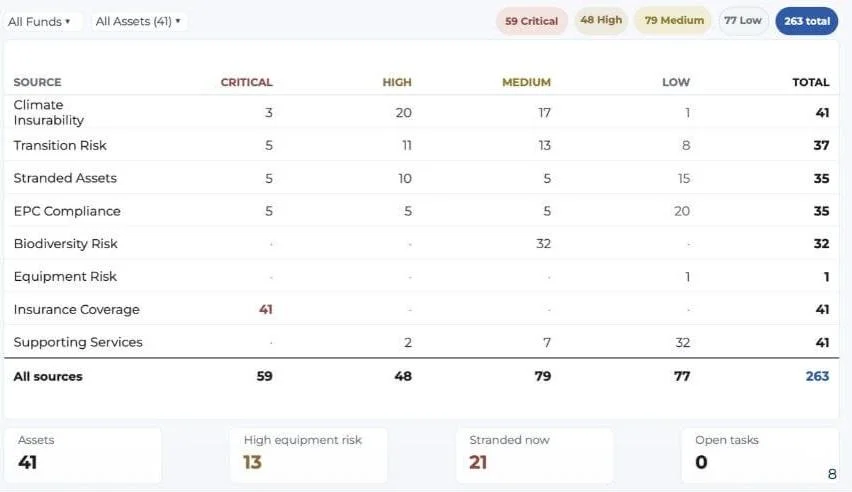
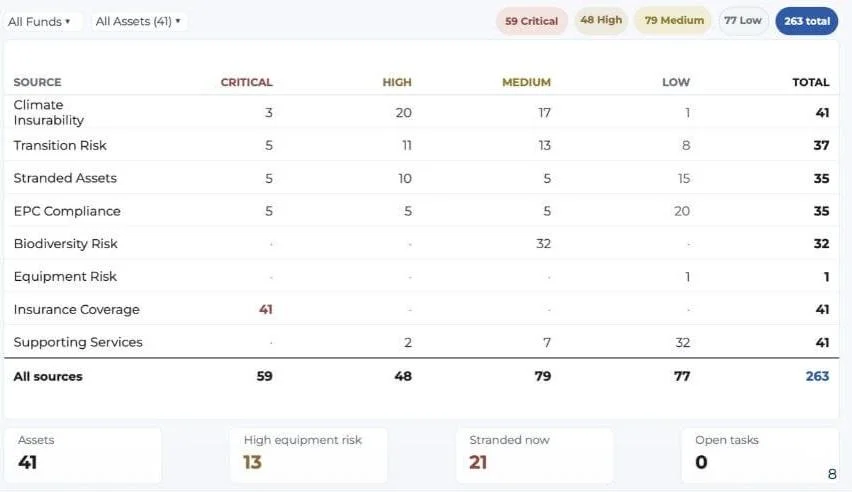
ESG Playbook’s new real estate dashboard brings climate exposure and retrofit costs into property screening, giving investors, asset managers and lenders a way to assess risks earlier in the deal process. Its central promise is to look beyond a building’s asking price and estimate the costs and funding needs tied to ownership. That matters because a property’s purchase price can say little about the work required to keep it operating, insured and aligned with changing expectations for energy performance.
The product is aimed at a familiar problem in property analysis: teams may have to screen many opportunities before they can investigate each building in depth. Early estimates can help sort that pipeline, but they’re only as useful as the underlying data and assumptions. The dashboard’s value will depend on whether users can trace those inputs and distinguish a measured building condition from a modelled risk.
From portfolio screening to building-level costs
The platform uses AI-assisted screening to review large opportunity pipelines for overall risk, data gaps, climate adjustments, net operating income trajectory, tenant and rent roll sensitivity, and comparable transactions. It also estimates when an asset may fall out of line with CRREM decarbonization pathways, alongside retrofit capital costs, stranding discounts, vacancy risk and adjusted value. Taken together, those measures connect climate exposure with financial questions that property teams already ask: how income might change, what work an asset could need, and how those factors affect its value.
That connection is useful, but it doesn’t make an early screening estimate a substitute for property-level diligence. A rent roll can change, equipment records can be incomplete, and retrofit costs depend on the building and the work required. The dashboard says it can flag data gaps, which is an important feature: a missing record should be visible to a decision-maker rather than quietly absorbed into a confident-looking score.
For physical exposure, the dashboard examines how hazards could affect nearby services, roads and utilities. That widens the analysis beyond the building itself. A property can depend on infrastructure and local services that shape access and day-to-day operations, so an assessment focused only on the structure may miss relevant exposure.
The platform includes insurance and insurability information, and matches equipment upgrades with incentives, tax credits, green loans and transition funding. Building records cover equipment lifecycles, energy performance, warranties and servicing. This is more significant than it looks: tying a proposed upgrade to equipment history and possible funding can help teams turn a broad climate concern into a list of decisions they can investigate.
And yet, identifying a possible funding source doesn’t establish that a project qualifies or that the money will be available on the terms a buyer expects. Those details still need to be checked against the specific asset and its financing plan. A screening tool can make that work more visible; it can’t remove the need for it.
Connecting property analysis to reporting
Users can track real estate benchmarks and carbon tax modeling deadlines through the platform’s global, property-focused regulation monitoring. The dashboard also connects with ESG Playbook’s carbon management tools for Scope 1, 2 and 3 reporting aligned with the GHG Protocol, TCFD, ISSB and CSRD, as well as the EU Taxonomy and SFDR. Lenders can use it to support PCAF financed-emissions reporting.
Bringing property analysis and reporting into one workflow may reduce the distance between an asset-level decision and the figures an organization later has to explain. But different reporting frameworks serve different purposes, and the platform’s stated alignment doesn’t by itself show how each estimate is produced or reviewed. For users, the practical question is whether they can follow a figure from its source data through to the reporting output.
That audit trail matters especially when teams compare properties or revisit a decision after assumptions have changed. If you're working in this space, you’ll want to know which inputs are building-specific, which rely on external data, and how the platform handles gaps. (And this is the part most people overlook.) A useful dashboard should make uncertainty legible, not just present a tidy result.
What the dashboard could change for deal teams
CEO and founder Sonia Zugel said investment teams need defensible figures to plan for climate and transition risk. They should be able to explain what work a building needs, when it’s due, which funding could help cover it and where the estimates came from. That framing puts traceability at the center of the product’s pitch: teams need a basis for their choices that can be examined by colleagues, lenders and other stakeholders.
Here's the thing: putting retrofit costs into screening could change when a team asks whether a property still makes sense. If likely work and funding needs appear before a deal advances, buyers can weigh those costs alongside income, tenant sensitivity and adjusted value. The numbers here are underwhelming if they’re treated as precise forecasts without evidence; they’re more useful as prompts for targeted follow-up.
That focus on traceable costs gives deal teams a clearer basis for deciding which properties merit deeper due diligence—and what ownership could require after closing. It may also help asset managers prioritize work across a portfolio, provided the records are current and the estimates can be checked against conditions on site.
Potentially useful. The proof will be in how well the estimates hold up when teams move from screening to inspection, budgeting and reporting.



Discussion
Sign in to join the discussion.