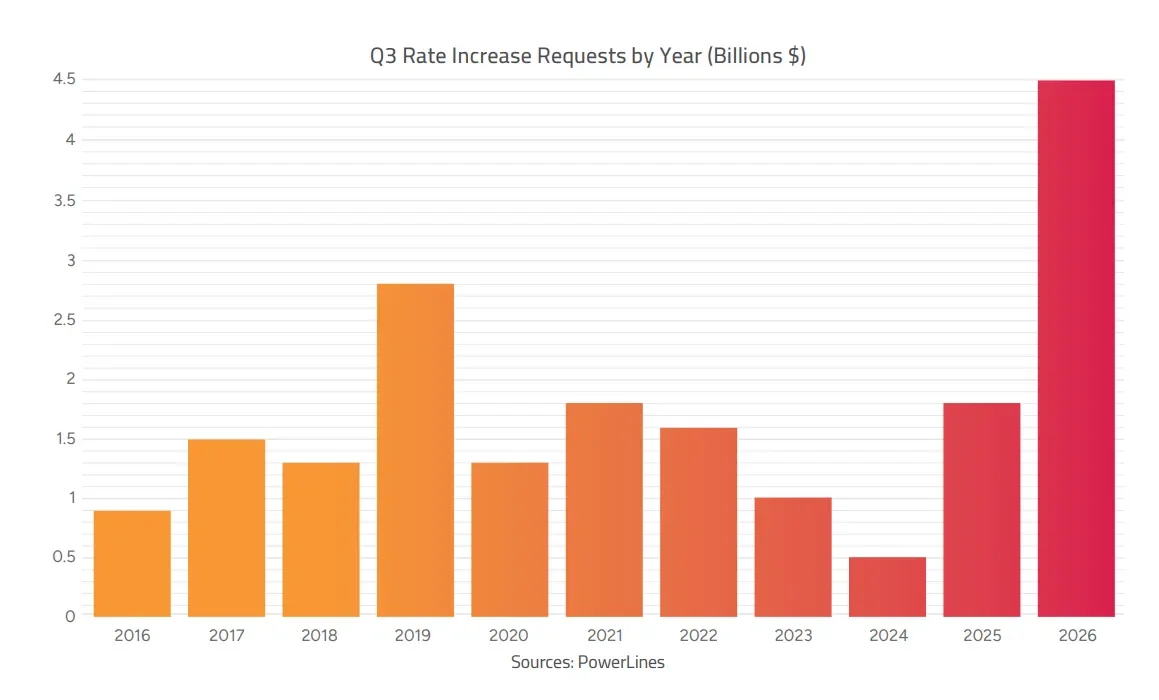
Investor-owned utilities have filed for a staggering $4.5 billion in rate increases in Q3 2026, a reflection of rising utility costs amid market pressures.
Investor-owned utilities across the U.S. have sought approximately $23.1 billion in electric and gas rate increases in 2026, considerably influenced by a record $4.5 billion filed in the third quarter, as outlined in a recent PowerLines report. This figure represents more than double the rate requests from the same period last year, which raises questions about the sustainability of current energy pricing. Utility companies are navigating a contentious environment where demands for reliability and affordability are colliding.
Political Climate and Rate Increases
According to Charles Hua, founder and executive director of PowerLines, “This quarter’s rate increase requests reflect an ongoing rise in utility costs.” As electric and gas rates keep climbing, the upcoming midterm elections might thrust energy affordability into the spotlight. Voter concerns about rising costs are mounting, especially as data center operations expand and consume more power. This context creates a potent mixture: on one hand, utilities argue they need funds to upgrade infrastructure, while on the other, consumers face tightening budgets.
Rising Energy Prices: The Consumer Impact
The North Carolina Clean Energy Technology Center reported a 7.3% average increase in residential electricity prices nationally from April 2025 to April 2026. Consumers aren't just watching energy bills increase; they face a broader spectrum of rising costs during the winter months. Households relying on electric heating can expect to pay around 9% more than what they paid last winter. Gas users will see a 5.8% bump, while those using propane should brace for an 8.7% rise. Natural gas bills seem relatively moderate compared to the staggering 31.3% increase projected for heating oil users. (And this is the part most people overlook: oil prices have been notoriously volatile, impacting more households than you might think.)
Investment Trends in the Utility Sector
The surge in electricity rates can be traced back to utilities ramping up investments to meet escalating energy demands. The Edison Electric Institute outlined that utility capital expenditures are set to exceed $1.1 trillion between 2025 and 2029. However, a PowerLines analysis predicts that these expenditures might jump by roughly 21% to $1.4 trillion by 2030. This upward trend in spending signals a strong push by utilities to enhance grid resilience and security—a response to increasing extreme weather events and heightened energy requirements.
Dani Marx, a spokesperson from the Edison Electric Institute, made clear that utilities are committed to balancing reliability and affordability. “The investments we make, from strengthening the grid to preparing for increasingly severe weather, support that goal,” she stated via email. This suggests an acknowledgment of their dual role: being a service provider while also addressing the realities of climate change and infrastructure decay. State regulators are tasked with conducting rigorous reviews for each rate request, but consumers may question if these reviews are sufficient in safeguarding their interests. Are all stakeholders genuinely being represented in these negotiations?
Local Utilities' Rate Requests: Spotlight on FirstEnergy
Among the notable rate requests, FirstEnergy's Jersey Central Power & Light (JCP&L) proposed a $253 million increase in base distribution rates in July. Coupled with a recovery plan for $476 million in deferred storm costs spread over a decade, this move is indicative of how utilities view long-term investment strategies. JCP&L claims this means the average residential customer's bill may increase by around 8.8%, but these changes won't take effect until 2028. The delay raises eyebrows: is this an effort to soften the immediate impact on customers, or is it merely postponing the inevitable? The balancing act between infrastructure investments and customer affordability remains delicate.
JCP&L’s approach exemplifies the tension utilities face: they must make essential infrastructure investments while minimizing customer impact. This dual goal, while commendable, can lead to frustration among consumers who may feel caught in the crossfire of corporate strategy and regulatory limitations.
Regional Trends in Rate Increases
The report from PowerLines highlighted several major rate requests from other utilities such as Oklahoma Gas & Electric, Indiana-Michigan Power Company, Dominion Energy Virginia, and CenterPoint Energy in Texas. Collectively, utilities in the Southern region, serving around 11 million customers, have requested $2.2 billion so far this year, contributing to a staggering total of $9 billion in rate requests overall. These requests aren't just numbers; they reflect the operational realities of utilities as they grapple with both consumer expectations and environmental pressures.
Utilities in the Northeast, servicing approximately 5.6 million customers, have sought $900 million in rate hikes just in the third quarter. Meanwhile, those in the Midwest and West have submitted requests for $800 million and $600 million, respectively, affecting a combined 28.7 million customers. This raises an essential question: are these requests being evaluated with input from the communities they serve?
Future Outlook: What This Means for Consumers
With utility costs poised to rise significantly, the implications for consumers are immense. If you're working in this space, consider how these trends may shape not just individual budgets, but broader policy discussions around energy accessibility and climate resilience. As the landscape shifts, consumers will likely push for more transparency and accountability in how utilities allocate their investments. Moreover, the impending political climate surrounding these issues may force utilities to better communicate their strategies and justify rate increases.
Editor's note: This report has been updated to include comments from the Edison Electric Institute.



Discussion
Sign in to join the discussion.